(Excerpt from the book ‘The Greeks in the Horn of Africa’)


(Excerpt from the book ‘The Greeks in the Horn of Africa’)
[excerpt from the book ‘The Greek community in Burundi-Rwanda’)
In the early 1930s, the region of eastern Congo was in a process of economic development a fact which also influenced Burundi. The Belgian administration was trying to connect the Katanga rail network, to the towns that were on the western shore of Lake Tanganyika in order to obtain a better and faster transport of goods. For that reason, a railway line reached the port of Kalundu aiming to link the Belgian with the British railway line that crossed the south of the Congo, inside the territory of Rhodesia. According to the plan, the line would pass through Uvira which the Belgians had chosen to develop into a main commercial port on Lake Tanganyika. Due to problems that came up, the project was not completed. This fact led the Belgians to choose Usumbura (cur. Bujumbura) in Burundi as the new major hub of the area. Indeed, Usumbura attracted a flow of railway workers who stayed in the city’s two Greek-owned hotels. Soon, Greek traders from Congo expanded their activities.

One of the first activities of the Greeks in SA was the operation of tea rooms.
This is the business of Phitidis in Johannesburg

(Excerpt from the book ‘The Greek community in Tanzania’)
Philipos Filios left Northern Epirus and immigrated to Zanzibar in 1891. Three years later he moved to South Africa. In 1900, he settled in Mombasa where he opened the ‘Cecil Hotel’ along with his brother Michael. That time, a few Greeks were settled in the city and were involved in trade activities. A decade later, Philipos Filios left for Kilimanjaro where he dealt with coffee plantations. He was one of the pioneers of the Greek community of Moshi in Tanzania.

The Greek community of Mozambique maintained close links with their homeland. During the Balkan wars and the First World War, the Greek community of Beira offered money for the relief of the victims.


(Excerpt from
the book ‘The Greek community in Mozambique’)
Between 1899 and 1902, the second war between the British and the Boers took place in South Africa. Few Greeks fought alongside the Boers and some of them who used to be traders in Transvaal, lost their properties as they were confiscated by the British. Therefore, to avoid the death or the confinement in the concentration camps, few of them fled to the nearby Lourenço Marques in Mozambique.


(Excerpt from the book ‘The Greek community in Tunisia 16h-21st cen’)
George Stravelakis or Halkias was born in 1817on the island of Chios. During the Chios massacre, Georgios's father was killed, while Georges along with his brother Ioannis and his mother Irene were captured and sold into slavery by the Ottomans. George was then taken to Smyrna and then Constantinople, where he was sold as a slave to the bey of Tunis. Stravelakis converted to Islam and was given the name Mustapha. He was raised by the family of the local Bey and soon became the state treasurer (khaznadar). He managed to climb to the highest offices of the Tunisian state and was promoted to lieutenant-general of the army, bey in 1840 and then president of the Grand Council from 1862 to 1878.
Mustafa Khaznadar retained memories of his Greek origin and supported his family in Greece by sending them money. Mustapha Khaznadar was a great benefactor to the Greek community of Tunis. In 1864 he donated an area of 9,905 sq.m. to be used as a cemetery. Later, in this area the church of St. George was erected. As a minimum recognition of Khaznadar's offer to the Greek compatriots, the Greek community of Tunis placed an honorary inscription.


(Excerpt from the book ‘The Greek community of Tanzania’)
Archimandrite Nicodemos Sarikas left Asia Minor in the early 20th
century and immigrated to South Africa in 1907. In 1912 he settled in
Moshi of Tanganyika where he started his missionary work and applied for
a plot in order to become a farmer. Since the German admi
nistration
refused, in August of 1912, Antonis Mamakos offered him a small plot and
a house inside his estate. Finally, a few months later with the
intervention of a few members of the local Greek community, such as
Kostas Meimaridis, Michael Filios, Evriviadis Panagiotakopoulos and
Michael Lamos, he was granted a plot of 30 acres. A few years later,
inside this plot the first orthodox church of Tanganyika was built.

(excerpt from the book ‘The Greek community in Mozambique’)
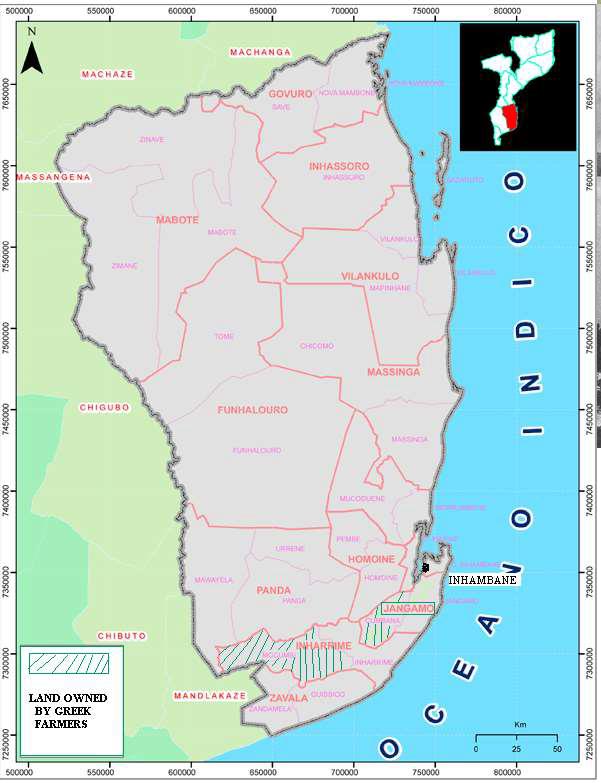
Apart from the Greeks who settled in Lourenço Marques or Beira in the
19th century, there were others who continued towards the province of
Inhambane. They boarded on a ship in Lourenço Marques and after nearly
40 hours they reached the port of Inhambane. In Inhambane, they got on
the train either for Jangamo, a small town at a distance of 30 km
or Mocumbi. The arduous journey did not end in Inhambane since many
Greeks had to ride horses or to walk for several kilometers through the
jungle to arrive at their settlement places. Those pioneer farmers lived
in round huts, 4-5 metres in diameter, covered with leaves and
branches. Each hut consisted of one or two rooms, with a bed and a small
table inside it.
Greeks from Asia Minor and the islands of Aegean
mainly settled in these areas and leased land by the Portuguese
government. They engaged in agricultural production, especially in the
cultivation of sugar cane. Some of the pioneers were: Michael Lygeros
from Plomari, Michael Nicolaou from Cyprus, Dimitris Kalliontzis from
Smyrna, Aristides and Apostolos Angelidis from Kırkağaç (Asia Minor),
John Vlassopoulos from Ayvalık (Asia Minor), Dimitris Pagonis from
Chios, Panagiotis Avgoustatos from Kefalonia and George Spellas from
Spetses.

In 1921, a fundraising conducted by the Greek State. Greeks throughout the world offered money.
Here is the offer of the Greeks of Elisabethville (pr. Lubumbashi) in Congo.


(Excerpt from the book ‘The Greek community in Mozambique’)
Although the Greek presence in Mozambique dates back to the 1880s, the first organised effort to establish a community took place in the late 19th century in the city of Beira. Greeks from Lemnos and Kasos were the pioneers in this initiative. In 1902, in the hall of the hotel ‘Victoria’ which belonged to Costas Piperis from Kasos, the ‘Greek Community of Beira’ was founded.

