Πέμπτη 17 Νοεμβρίου 2016

Tο ξενοδοχείο θρύλος του Burundi

(απόσπασμα από το βιβλίο «Οι Έλληνες στο Burundi και τη Rwanda»)


To 1928, ο Κώστας Σημαντήρης από τη Λέσβο άνοιξε το πρώτο ξενοδοχείο στο Burundi, το «Hôtel Central», στην κεντρική πλατεία της Bujumbura. Το 1929, μετά από πρόσκληση του Κώστα Σημαντήρη, ήρθε στη Bujumbura ο συμπατριώτης του Νίκος Παγίδας. Αφού δούλεψε για λίγο στο ξενοδοχείο του Σημαντήρη, αγόρασε ένα σπίτι με θέα την λίμνη, το διαμόρφωσε και τον ίδιο χρόνο άνοιξε το «Hôtel du Lac».
Το 1931 ο Νίκος Παγίδας προσκάλεσε στο Burundi τον γαμπρό του Βάσο Χαϊδεμένο, ο οποίος έγινε συνέταιρος του στο ξενοδοχείο. Το 1940, οι ιδιοκτήτες αγόρασαν ένα μεγαλύτερο οικόπεδο από το οποίο παραχώρησαν 20 στρέμματα, προκειμένου να ανεγερθεί ένα ποδοσφαιρικό στάδιο. Το 1941 το ξενοδοχείο λειτούργησε με 28 δωμάτια ενώ μετονομάστηκε σε «Hôtel Paguidas». Από το 1941 και μετά, το «Hôtel Paguidas» αποτέλεσε σημείο αναφοράς για την Bujumbura καθώς φιλοξένησε την élite της πολιτικής και οικονομικής ζωής που πέρασε από το Burundi,συμπεριλαμβανομένων βασιλιάδων, πολιτικών ηγετών και στρατιωτικών αξιωματούχων.


Η Λίστα των εθελοντών της Ελληνικής Παροικίας του Σουδάν, την περίοδο του Β΄ Παγκοσμίου Πολέμου

(πηγη: Σύλλογος Ελλήνων Σουδάν)


Η προσφορά της ελληνικής κοινότητας του Port Sudan στη διάρκεια του Β΄ Παγκοσμίου πολέμου

(προδημοσίευση από το βιβλίο «Η ελληνική παροικία του Σουδάν 19ος-21ος αι.) 


Το ξέσπασμα του Β΄ Παγκοσμίου πολέμου κινητοποίησε όλο τον ελληνισμό του Σουδάν. Οι Έλληνες του Port Sudan, πέρα από την διενέργεια εράνων, παραχώρησαν το σχολείο προκειμένου να χρησιμοποιηθεί ως νοσοκομείο για τις ανάγκες του ελληνικού στόλου που προσάραξε στην περιοχή.
Μάλιστα η κοινότητα του Port Sudan συγκέντρωσε χρήματα για την συντήρηση των ελληνικών πλοίων, κίνηση για την οποία τιμήθηκε με το «Χρυσό Σταυρό του Φοίνικα» και με το παράσημο του «Ελληνικού Ναυαρχείου».


Ο Ιερός Λόχος συμμετέχει στην απελευθέρωση της Τυνησίας από τις δυνάμεις του Άξονα, στη διάρκεια του Β΄ Παγκοσμίου Πολέμου

Την περίοδο 1942-1943, η Τυνησία αποτέλεσε θέατρο τριών μεγάλων επιχειρήσεων από τις Συμμαχικές Δυνάμεις κατά του Άξονα. Στο πολεμικό μέτωπο της Τυνησίας ενεπλάκησαν και ελληνικές στρατιωτικές δυνάμεις, τμήμα του «Ιερού Λόχου» που συγκροτήθηκε κατά τη διάρκεια του Β' Παγκοσμίου Πολέμου το 1942 στη Μέση Ανατολή, υπό τις οδηγίες του συνταγματάρχη Τσιγάντε. Έλαβε μέρος σε αρκετές επιχειρήσεις απελευθερώνοντας πόλεις στα νότια της χώρας, όπως το Gabès, το Wadi Akarit και η Sousse. Οι απώλειες του «Ιερού Λόχου» στη διάρκεια των πολεμικών επιχειρήσεων στην Τυνησία ανήλθαν σε 3 νεκρούς : Ι. Αγλαμίση, Γρ. Μπουρδάκο, Α. Λαφογιάννη και δύο αγνοούμενους: Α. Αναγνωστίδη, Π. Τσαουσόπουλο, προς τιμή των οποίων ανεγέρθηκε μνημείο στον προαύλιο χώρο της εκκλησίας του Αγ. Γεωργίου στην Τύνιδα.


The significant role of the Greeks in the economy of Sfax and Djerba in Tunisia

(abstract from the book ‘The Greek community in Tunisia’)


The Greek community in Sfax and Djerba, which was formed in the 1860s, ranged from 500 to 1000 people between 1890 and 1930. Since the Greek presence was connected to sponge fishery, almost 3000 divers moved to Sfax on a temporary base. Between 1910 and 1940, a few members of this community became successful entrepreneurs with great economic power. They took advantage of the wider changes in the sponge industry and became connected to the international trade networks. Their contribution to the local economy was significant since they were the major sponge exporters of Tunisia. During the 1930s and 1940s, the main sponge merchants of Sfax were Panagiotis Balourdos, Emmanuel Ambelas, Michael Arfaras, Spyros Vouvalis, Charalambos Galanos, Kostas Katsaras, Michael Kindynis, Emmanuel Korfias, Nomikos Koutouzis, Antony Kolettis, John Malamatos, John Balourdos, Nick Ntantakos, Theocharis Tataris, Kostas Tzathas, Michael Tsagaris, Nick Tsagaris and John Kindynis. These Greek merchants owned more than 3,000 sponge units and they controlled the local economy for more than two decades.


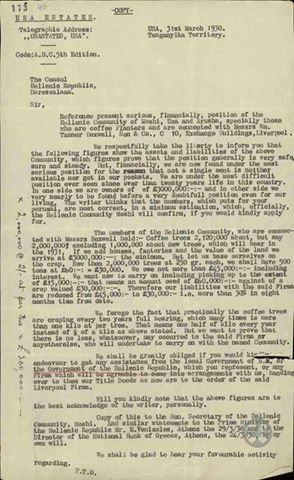
The problems of the Greek farmers in Tanganyika in 1930.

Letter of L.P. Christianakis to the Consul of Greece in Tanganyika (31/3/1930). He presents the bad economic condition of the Greeks coffee farmers in Moshi, Usa and Arusha and asks the Greek Consul to achieve financial assistance either from the government Tangkanika or the Greek government.


The Greek pioneer tobacco farmers in Rhodesia

During the late 19th century, few Greeks were involved in the tobacco cultivation in the Southern Rhodesia. In 1904 George Odlum of the Department of Agriculture was sent to the United States to study tobacco culture; his report did much to establish tobacco growing on a sound basis. Later, in 1907, as a result of a visit by Odlum to Greece and Asia Minor, 14 Greek growers arrived in the Colony to found the Turkish tobacco industry. The introduction of Turkish tobacco in 1910 gave a market advantage to growers in the north-eastern high veld, where climatic conditions had already proved themselves more suited to tobacco growing than in the midlands. Consequently, as the output rose from 100,000 pounds in 1910, the first year of commercial production, to 3,062,000 pounds in 1913. From 1910 to 1913 almost the entire output was marketed in South Africa. In 1914 a large consignment was sent to Britain.


Dimitris Tsafendas , the Greek hero from Mozambique who opposed apartheid

(abstract from the book "The Greek presence in Mozambique")
Dimitris Tsafendas was born in Lourenço Marques on 14/1/1918.
His father, Michael Tsafendis, emigrated from Crete in 1915, and worked on the farm of his compatriot Antonis Kalogerou.


He got in love with Amelia Williams, a Mozambican of mixed race, and had a son, Dimitris. Amelia died quite soon, and Dimitris grew up with his grandma Catherine, who lived in Alexandria of Egypt. As his grandmother had grown up and was not able to take care of him, he returned to SA in 1928. In the meanwhile, his father got married to a Greek woman, Marica, and had moved to Pretoria in South Africa. Since Marica did not give much attention to Dimitris, he left for Mozambique and changed his surname to Tsafendas.
In his adolescence, he returned to South Africa and worked as a labourer. He was organized in the Communist Party due to his political beliefs and because no other political party accepted the mestiços (people of mixed race), including the African National Congress (ANC). In 1942, he worked as a sailor and travelled to Canada and USA. During a period of 20 years, he travelled a lot, learned eight languages, and acquired many experiences that influenced him.
In 1957, he participated in the unarmed demonstration of 20,000 coloured South Africans in the town of Sharpeville, a few kilometres outside of Johannesburg, where 20 police officers killed 69 people and wounded 830, including Dimitris Tsafendas.
In 1964, he returned to Mozambique. By the death of his father, he got back to South Africa. According to the apartheid laws, he was a mulatto. As a result, he had difficulties in finding a job. Without any help, he moved to Cape Town and stayed with a black family. He fell in love with their daughter and wanted to marry her, but apartheid laws did not allow marriages between people of different race.
That period, Antonis Kalogirou, a landowner from Durban, helped him to find a job in the Parliament of South Africa. On September 6th, 1966 at 14:30, Tsafendas assassinated the prime minister of South Africa who died three days later. The trial started on 20/10/1966 and lasted four days. Tsafendas refused the defense lawyer and declared "I did my duty. Kill me". Initially, the judges condemned him to death. Nevertheless, the government of South Africa in its effort to avoid the political effect made the judges changes their verdict. Finally, they sentenced him to imprisonment since his crime resulted from his mental illness. Tsafendas was transferred to a high-security prison in Pretoria and was tortured on a daily basis.
He died on 10/10/1999 and the Greek community of Krugersdorp covered the cost of his funeral. He was buried without a gravestone, only with a stone with the number J59 inscribed on it, the number he had as a prisoner.
It was a desperate attempt by the government of South Africa to eliminate the presence of one of the most controversial personalities in the history of Africa.
Tsafendas is a hero, a free man who dared to oppose apartheid. He became the symbol of the struggle against the apartheid and in the great demonstration of 1976 in Johannesburg, people chanted rhythmically “Tsafendas inyanga yezizwe” (Tsafendas liberated the nation). Tsafendas passed into oblivion even after the end of apartheid. The new government of ANC treated him as a mental patient. Although he was a pioneer in the struggle against the apartheid, no one ever made any reference to his role. Nelson Mandela, in his autobiography ignored him on purpose. After the election of Mandela in 1994, Tsafendas remained in prison although he had serious health problems.


The Greek church of Beira


(abstract from the book ‘The Greek community in Mozambique’)

In 1896, the Greeks of Beira used a small house as a church and Bakas was the first vicar of the parish. He was succeeded by Vasilis Kamitsis, who remained in Beira from 1902 until 1927, and then, in 1928 by Theophilos Siminakis, who died in 1930. Nikolaos Scandalis, who was also a teacher, was the next priest of the parish.
In 1937, the community decided to erect a church. On 14/8/1938, the temple of the Holy Trinity was founded, on a land donated by the “Compagnia de Moçambique”.
Athanasios Kleronomos, Dimitris Verghis, Dimitris Paraskevas and Efterpi Paraskevas were among the most important donators. The project cost 3,200 gold sovereigns. The Greeks of Manica conducted a fundraising campaign and collected 3,400 gold sovereigns. However, the most significant donation was that of Efterpi Paraskevas, who offered 500 gold sovereigns.


Δευτέρα 18 Ιουλίου 2016

The Greek pioneers in Lourenço Marques of Mozambique


(abstract from ''The Greek community in Mozambique''

The Greek presence in Lourenço Marques dated back to 1878 and is related to the political and economic conditions in the neighbouring Transvaal area of South Africa. During the 1880s, a few Greeks immigrated to South Africa to work in the diamond mines of Kimberley and in the gold mines of Witwatersrand also included Greeks. During the wars between the British and the Boers (1880-1881, 1899-1902) the mines ceased their operation and few workers moved eastwards and settled in Lourenço Marques.
Some of them remained temporarily, until the reopening of the gold mines in Transvaal. However, because of the extremely difficult and unhealthy working conditions in the diamond mines of Kimberley and the gold mines of Johannesburg, many workers resigned. Some of them made a career change and remained in South Africa while others moved to the nearby Lourenço Marques. 


The Greek emigration flow, from South Africa to Lourenço Marques, intensified with the beginning of the works on the railway line, which departed from the port of Lourenço Marques and ended in the heart of the Transvaal, in Pretoria. Some of the Greek immigrants of the late 19th century were John Mihaletos, Dimitris Sideris, Dimitris Spanos,Efstratios Daskalakis, Joseph Liarantonakis, Panayiotis Adrianopoulos and Vasilis Kastritsios.


Δευτέρα 4 Ιουλίου 2016

The Greek beer of Africa


(abstract from the book "The Greek community in Mozambique")

Μichael Perantonakis, usually known as Cretikos because of his origin from the island of Crete, immigrated to Mozambique in the late 19th century. Although he intended to work in the mines of South Africa, he settled in Lourenço Marques where he started to sell bananas. Then he started a grocery store, and at the end of the first decade of the 20th century, he began to sell drinking water in the neighbourhoods of Lourenço Marques. During this period, the Greek merchant noticed the lack of ice, which was necessary to preserve the fish and decided to get involved in the production field. 


In 1915, he founded the company ‘Vitória’ and in 1916, he erected an ice factory with the name ‘Vitória Cold Storage and Ice Factory, Ltd’. It was located on the west side of the city, in the Praia do Polana, in front of the Avenue of the Republic and opposite the ‘Olympia’ café and fish market. In the following years, Perantonakis expanded his business in the bottling of mineral water and the production of soft drinks. Since he decided to enter also into the brewery field, he travelled to Germany to consult experts on the production method. In 1932, Perantonakis used a European recipe and having followed high standards at all the stages of the production, he produced a beer under the trade name ‘Laurentina’. 


In 1935, ‘Laurentina’ acquired 50% of the domestic market. During the 1950s and the 1960s, the brewery of Perantonakis implemented strategic alliances and a series of investments in the production sector. In 1959, two new units were erected beside the original plant. The cost of this investment exceeded $200 million. 


The quality of ‘Laurentina was improved and for that reason it won six gold medals in the world beer competition held in Brussels. By the independence of Mozambique in 1975 and the economy policy followed, the brewery were nationalised under the body of ‘SOGERE’ (Sociedad General de Cervejas e Refrigerantes de Mocambique SARL). In 1997 the company was acquired by the French BGI-Castel and the Irish Guinness, and in 2001 it was sold to the SABMiller.